Blog
Health Benefits of Drinking Water from Copper Bottles
So how did the classical Latin become so incoherent? According to McClintock, a 15th century typesetter likely scrambled part of Cicero’s De Finibus in order to provide placeholder text to mockup various fonts for a type specimen book. It’s difficult to find examples of lorem ipsum in use before Letraset made it popular as a dummy text in the 1960s, although McClintock says he remembers coming across the lorem ipsum passage in a book of old metal type samples. So far he hasn’t relocated where he once saw the passage, but the popularity of Cicero in the 15th century supports the theory that the filler text has been used for centuries.
Don’t bother typing “lorem ipsum” into Google translate. If you already tried, you may have gotten anything from “NATO” to “China”, depending on how you capitalized the letters. The bizarre translation was fodder for conspiracy theories, but Google has since updated its “lorem ipsum” translation to, boringly enough, “lorem ipsum”. One brave soul did take a stab at translating the almost-not-quite-Latin.
According to The Guardian, Jaspreet Singh Boparai undertook the challenge with the goal of making the text “precisely as incoherent in English as it is in Latin – and to make it incoherent in the same way”. As a result, “the Greek ‘eu’ in Latin became the French ‘bien’ […] and the ‘-ing’ ending in ‘lorem ipsum’ seemed best rendered by an ‘-iendum’ in English.”
Find Your Focus While Working
As an alternative theory, (and because Latin scholars do this sort of thing) someone tracked down a 1914 Latin edition of De Finibus which challenges McClintock’s 15th century claims and suggests that the dawn of lorem ipsum was as recent as the 20th century. The 1914 Loeb Classical Library Edition ran out of room on page 34 for the Latin phrase “dolorem ipsum” (sorrow in itself). Thus, the truncated phrase leaves one page dangling with “do-”, while another begins with the now ubiquitous “lorem ipsum”.
Whether a medieval typesetter chose to garble a well-known (but non-Biblical—that would have been sacrilegious) text, or whether a quirk in the 1914 Loeb Edition inspired a graphic designer, it’s admittedly an odd way for Cicero to sail into the 21st century.
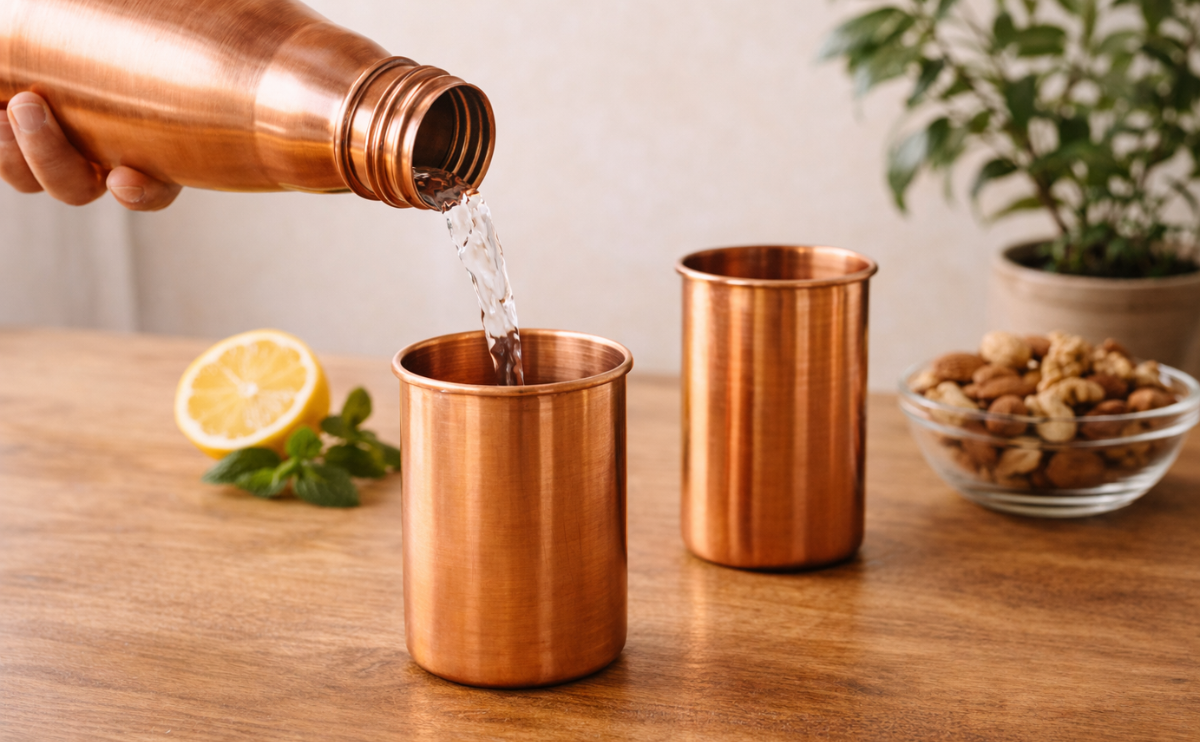
For centuries, drinking water stored in copper vessels has been a part of Indian tradition and Ayurvedic practice. Long before modern purification systems, our ancestors relied on copper utensils to naturally cleanse and energize drinking water. Today, as people return to holistic and natural wellness practices, copper bottles have regained popularity — not just as traditional décor pieces, but as powerful health-supporting essentials.
But what makes copper water so special? Is it truly beneficial? And how should you use a copper bottle correctly?
Let’s explore the science, tradition, and health advantages behind drinking water from copper bottles.
The Ayurvedic Connection
In Ayurveda, storing water in a copper vessel is known as “Tamra Jal.” It is believed that when water is stored in copper overnight (6–8 hours), it absorbs trace amounts of copper ions that help balance the body’s three doshas:
- Vata (air element)
- Pitta (fire element)
- Kapha (earth & water elements)
Balanced doshas promote overall physical and mental well-being.
While Ayurveda recognized these benefits thousands of years ago, modern science also supports many of copper’s natural antimicrobial and health-enhancing properties.
How Copper Purifies Water
Copper has natural oligodynamic properties, meaning it can kill harmful microorganisms.
When water is stored in a copper bottle for several hours:
Copper ions are released into the water
These ions destroy bacteria, viruses, and fungi
Harmful pathogens like E. coli and Salmonella are neutralized
This makes copper a natural purifier — without chemicals.
Drinking water from a copper bottle is not just a trend — it is a time-tested practice rooted in tradition and supported by science. From improved digestion to stronger immunity and glowing skin, copper water offers multiple health advantages when used correctly.
By incorporating this simple habit into your daily routine, you bring together wellness, sustainability, and heritage in one powerful step.